Junior Research Group Bacterial RNA Biology
Dr. Kathrin Fröhlich
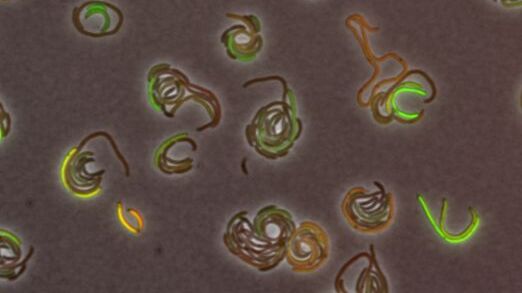
Bacterial small RNAs (sRNAs) act as key elements in regulatory networks to control gene expression at the post-transcriptional level. Most sRNAs function through direct base-pairing interactions with target transcripts, leading to changes in stability, processing and translation of the recognized mRNA. Their abilities to act on multiple transcripts and to exert both positive and negative regulation make sRNAs highly versatile and valuable molecules to help bacteria adapt to changing environmental conditions. While hundreds of sRNA candidates have been identified in genome-wide bioinformatic-based or experimental screens in enterobacteria, the bulk of studies investigating the function and mechanisms of sRNAs have been focusing on Escherichia coli or its close relatives. In our group, we use Caulobacter crescentus and Klebsiella pneumoniae as model organisms to study the principles of RNA-mediated processes in bacteria, and to uncover novel mechanisms of bacterial gene regulation.
Bioinstrumentezentrum, Room M1-E3
Winzerlaer Straße 2
07745 Jena
Bioinstrumentezentrum, Room M1-E3
Winzerlaer Straße 2
07745 Jena
Bioinstrumentezentrum
Winzerlaer Straße 2
07745 Jena
Manuel Velasco Gomariz
Maria Thamm (MSc. Microbiology)
Felix Späth (MSc. Microbiology)
Pia Müller (BSc. Biologie)
Maria Schreiber (BSc. Bioinformatik)