VEO and MGX lab retreat 2025
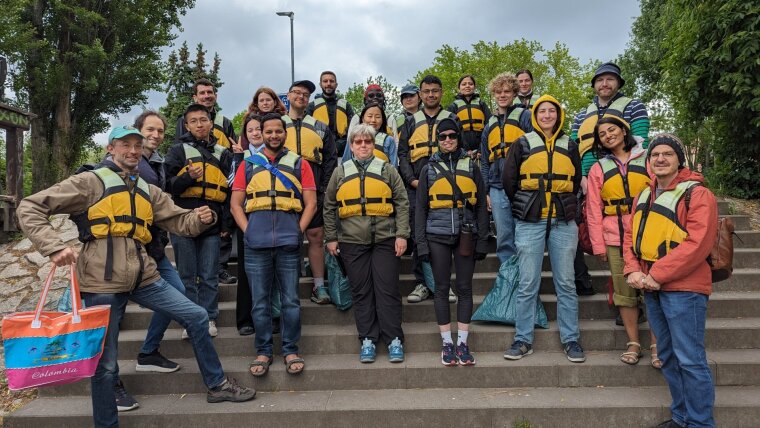
The Viral Ecology and Omics (VEO) Group from FSU Jena recently hosted colleagues from the Metagenomics (MGX) Group at Utrecht University for a fun and collaborative three-day lab retreat focused on team building.
Published: | By: Marcel Baecker
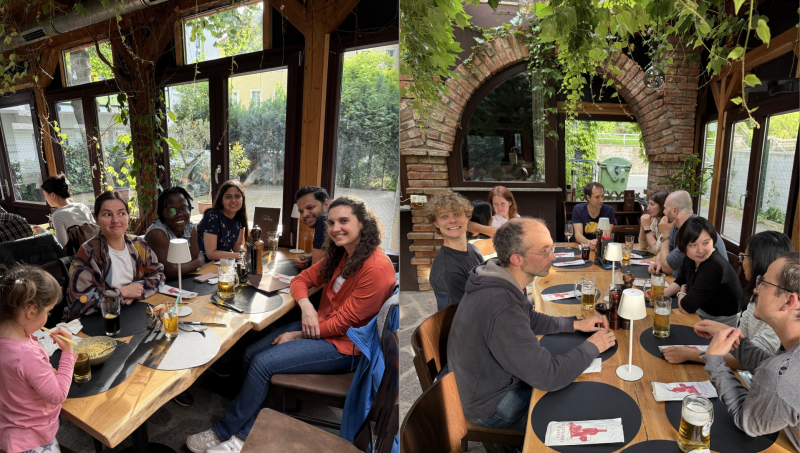
Dinner under the grapevines
Image: Varada KhotThe retreat kicked off with an evening at an Italian trattoria, where we mingled with our colleagues and guests in an informal setting over pizza, calzone, and other local Italian-Thurigian delicacies. Such a relaxed evening under the grape vines set the tone for collaboration and team building that carried over the whole retreat.
The second day featured the retreat's main team-building activity: a canoe trip from Jena to Dornburg. Boating teams were strategically formed to mix colleagues from Utrecht and Jena, as well as wet-lab and dry-lab researchers, to foster new interactions between people who don't typically work together. Water activities included fierce canoe races and hauling canoes in and out of the water, leaving some of us soggier than others. The only person who happened to bring extra clothes also took a surprise swim in the Saale! On the way, we anchored our canoes briefly at the Rabeninsel to refresh ourselves with a quintessential German beer… and lunch.
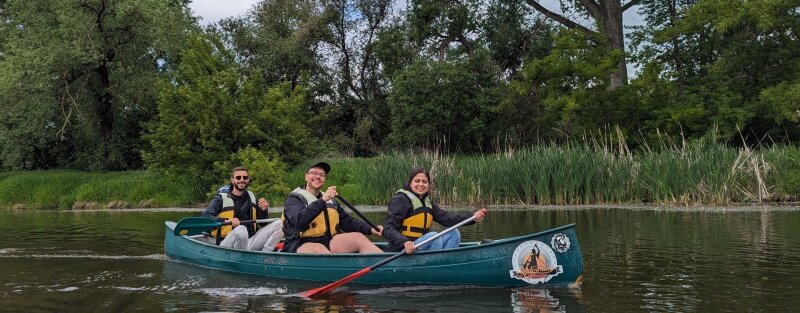
Aris, Rabia and Marcel paddling
Image: Varada KhotWhen our ships reached the Dornburg shores, we ascended up to the historic Dornburg Castle for warm tea and snacks, followed by a lively scientific program. The first activity was a fast-paced challenge, where teams built projects on the fly using randomly drawn keywords from a pool of scientific methods, concepts, and bioinformatic terms. Together with our teammates, we developed project proposals that were both imaginative and practical. Each team then had to pitch and defend their ideas, facing harsh critique from the rest of the group who were specifically asked to criticize other projects in order to stimulate fast critical thinking. “Nobel prizes” were awarded to teams that had the “most feasible” and also the “most hallucinatory” (crazy-creative) projects. This Dragon’s Den-style activity encouraged us to think outside the box, collaborate with colleagues, defend our methodologies, and ask critical questions in a playful environment.
Aris and Pim on the Saale
Video: Marcel Bäcker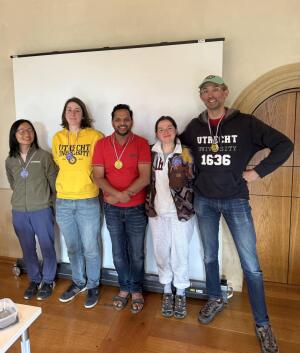
Most creative project winners
Image: Marcel BäckerWhen our ships reached the Dornburg shores, we ascended up to the historic Dornburg Castle for warm tea and snacks, followed by a lively scientific program. The first activity was a fast-paced challenge, where teams built projects on the fly using randomly drawn keywords from a pool of scientific methods, concepts, and bioinformatic terms. Together with our teammates, we developed project proposals that were both imaginative and practical. Each team then had to pitch and defend their ideas, facing harsh critique from the rest of the group who were specifically asked to criticize other projects in order to stimulate fast critical thinking. “Nobel prizes” were awarded to teams that had the “most feasible” and also the “most hallucinatory” (crazy-creative) projects. This Dragon’s Den-style activity encouraged us to think outside the box, collaborate with colleagues, defend our methodologies, and ask critical questions in a playful environment.
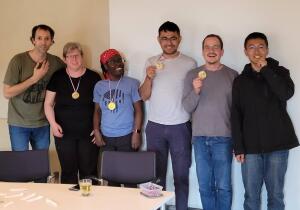
"Most feasible" project winners
Image: Marcel BäckerOur second activity was a timely discussion about the use of artificial intelligence applications such as ChatGPT in the context of research. We explored the benefits of AI for scientific writing, how and when to verify what ‘the Chat’ tells you, and also the ethical and environmental concerns surrounding the use of generative AI. Some ethical concerns included the vast amounts of energy required to train and run large language models and the fact that generative AI borrows its ideas from the creative inputs of the general public without any citation or credit. Ensuring that we cite the original work remains a key aspect of academic research. These ideas around the use of AI were then cemented into our lab code of conduct.
VEO and MGX at Dornburger Schlösser
Video: YuxuanAfter many hours of making waves, both in our canoes and our science, we returned to Jena via the Schienenersatzverkehr, rounding out our day with a typical Deutsche Bahn experience.
On the final day, we split into groups to visit the cities of Jena and Erfurt. The Jena group encountered closed museums and opted instead for ice cream followed by a trip up the Jen Tower. Meanwhile in Erfurt, the others visited a Thuringian history museum and, of course, also a local ice cream shop. Between the ice cream scoops and the sightseeing, we used the relaxed time to strengthen new friendships that were forged during the retreat. Finally, we said goodbye to our MGX colleagues who traveled back to Utrecht.